Most engineers who apply for AI-focused roles today have used AI tools. Far fewer have built the infrastructure that makes AI tools reliable in production. That gap is what our full stack AI engineer interview is designed to find.
When clients ask us to hire a Full Stack AI Engineer, they are not looking for someone who types prompts quickly. They want an architect who can design codebases that AI agents can work in, build tools that wrap business logic and expose it safely, and keep agent-driven systems honest once they are running. Finding that person takes a structured rubric, not a gut check.
We have written before about how we vet nearshore AI engineers at a high level. This article goes one level deeper: the scoring, the weighting, every dimension we assess, and the interview questions we actually ask.
We run two tracks. Our Head of AI runs the technical interview. Our team runs the non-technical interview. Both matter. A candidate who cannot explain their architectural decisions to a non-technical teammate is the wrong shape for this role, however strong their code is.
The core premise: AI tooling amplifies the engineering instincts a candidate already has. It does not install those instincts where they are missing. Our job is to find the instincts first.
What we are hiring for
The role rests on one mental model: the model is the engine, and the harness is everything around it.
The harness includes repo structure, MCP servers, custom tools, sub-agents, evals, guardrails, internal UIs, documentation, traces and automation pipelines. It turns model output into reliable products. A good harness makes a mediocre model useful in production. A bad one wastes a great model.
This is a mid-to-senior role. We do not put recent graduates forward, however AI-fluent they are. The harness only works if the engineer holding it has the production instincts to know what it should do.
We also screen out two opposite failure modes, both below bar:
- Delegates everything. Pastes whatever the agent produces, cannot defend the code and has no verification loop.
- Delegates nothing. Uses AI only as fancy autocomplete, has never built an MCP server, agent or internal tool, and will be slow.
If you are still deciding whether you need this profile at all, our guide to AI engineers vs full stack engineers who use AI covers the difference.
How our full stack AI engineer interview is scored
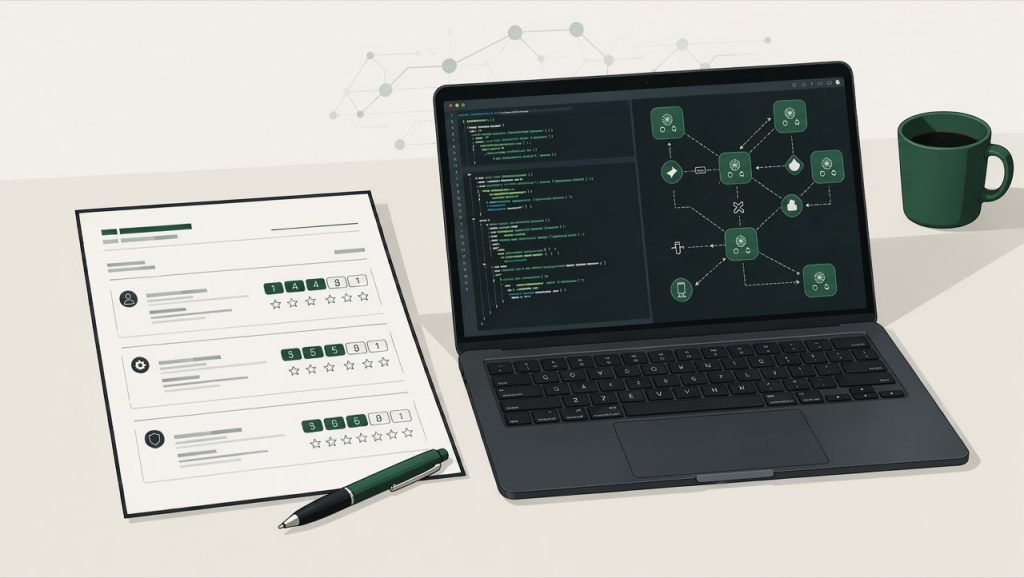
Every interviewer scores each dimension on the same 1 to 5 scale.
| Score | Label | What it means |
|---|---|---|
| 1 | Concerning | Active warning sign |
| 2 | Below bar | Would slow the team down |
| 3 | Meets bar | Could ship work in week one |
| 4 | Strong | Would raise the team’s ceiling |
| 5 | Exceptional | Hire even if there are no openings |
To move forward, a candidate needs an average of 3.5 or higher on each track, with no single score below 2.
The dimensions are not equal. On the technical track, five headline dimensions drive the decision: engineering judgment, the three harness layers (static, active and safety) and end-to-end product building. On the non-technical track, communication and empowerment mindset carry the most weight. These count roughly double.
Engineering fundamentals are a hard floor. A candidate who scores below 3 there does not move forward, however strong the rest of the scorecard looks. Our clients will be living inside what this person builds.
Track A: the technical interview
Our Head of AI runs this track as a system design discussion, a portfolio walkthrough and a live review of AI-generated code. It covers eleven dimensions. The first five are the headline dimensions.
1. Engineering judgment and problem solving (headline)
This is the skill AI tools do not replace. We want someone who can take an ambiguous business problem and break it into a system: data, interfaces, control flow, failure modes and ownership. Strong candidates raise latency, cost per request, accuracy, recoverability, observability and blast radius without being asked.
They also treat prompt injection, data exfiltration and over-permissive tool scopes as default threats, not afterthoughts. And they know when a problem does not need software at all.
2. Static harness: codebase architecture for AI legibility (headline)
A codebase that agents work well in looks different from one only humans touch. We look for candidates who:
- Have a clear point of view on repo layout, naming and module boundaries that keep context windows manageable
- Write machine-readable structure: clear types, JSON Schema or OpenAPI, predictable folders
- Maintain an honest AGENTS.md or CLAUDE.md with conventions, gotchas, commands and pointers to source files
- Set explicit autonomy boundaries: what an agent always does, asks about first and never does
- Use tests, type checks, linters and pre-commit hooks as guardrails when an agent is editing
3. Active harness: tools, agents, hooks and orchestration (headline)
Tools, MCP servers, hooks, sub-agents and orchestration are how a model is allowed to act. A good harness exposes the right actions at the right size, with clear types, useful error messages and a limited blast radius.
We look for someone who has built at least one MCP server or similar tool layer for real business actions, has used an orchestration framework and knows when to write their own, and designs multi-agent systems with narrow roles, constrained toolsets and clean handoffs. In production that means process isolation, network boundaries, per-agent secret scopes, rate limits and a kill switch.
4. Safety harness: evals, observability and autonomy (headline)
This separates engineers who can demo an AI feature from those who can keep one running. Strong candidates treat evals as real engineering work: offline eval sets, golden examples, regression gates in CI, and LLM-as-judge checks calibrated against human review of sampled traces.
We test for one insight in particular: “metric green, user red” is a real failure mode. Good engineers design for it with human review, dogfooding and customer feedback. They also build evals that can graduate into runtime guardrails, so the check that gates a release can also gate a tool call or escalate to a person.
5. End-to-end product building and MVP speed (headline)
For a small company this is not optional. A specialist who needs three other people in the room to ship an MVP is the wrong shape. We look for engineers who have taken products from idea to first customer across the whole stack: data model, backend, frontend, deployment, monitoring and basic ops.
6. Context and knowledge systems
The model is only as good as its context. Strong candidates choose deliberately between prompt context, retrieval (RAG) and structured tool calls, and can defend their choices on chunking, embeddings, hybrid search and reranking. They know the failure modes: stale data, irrelevant chunks, embedding drift and overconfident retrieval. They treat prompts and tool descriptions like code, with version control, review, evals and rollback.
7. Building for non-technical contributors
Non-engineers should be able to make routine changes without engineering becoming the bottleneck. We look for people who have built admin panels, CMS layers or configuration UIs that teammates actually rely on, with preview, approvals, audit logs and rollback designed in from the start.
8. Code review and verification of AI output
When the model writes most of the code, verification becomes the bottleneck. In the live review, we hand the candidate AI-generated code and ask what is wrong, what they would push back on and what they would accept. We are watching how they reject and refine, not whether they catch every bug. Red flags include merging large unreviewed changes and trusting invented APIs.
9. Engineering fundamentals and code stewardship (hard floor)
We expect production systems shipped and maintained over time, fluency in JavaScript, TypeScript or Python plus a backend stack, a solid grasp of HTTP, APIs, auth and application security, experience with containers, CI and cloud infrastructure, and codebases built to be maintained and debugged for years.
10. AI tool fluency
Candidates should have used at least two AI coding tools in real work and be able to compare them honestly. They should understand context windows, token budgets and why longer contexts can hurt quality.
11. Learning agility
The tooling shifts every few months. We want people who track new releases without being told, have tried a new tool in the last 60 days and can name what changed in the field this quarter. Saying “I don’t know yet, let me try it” is a green flag.
Track B: the non-technical interview
Our team runs this track. None of it requires writing code. The question is whether this engineer can work as a full team member, not just a technical contributor.
Communication and translation (headline). This person will spend real time helping non-engineers understand what is possible. We ask them to explain the last system they built as if we had never used it, and watch whether they reach for jargon or for the listener.
Empowerment mindset (headline). The most important values dimension in the rubric. The goal is to make non-engineers more capable, not more dependent on engineering. We want concrete examples of building something that let a non-technical person do a job that used to need a developer. Condescension or gatekeeping is a red flag.
The other six dimensions:
| Dimension | What we look for |
|---|---|
| Ownership | Talks in outcomes for users or the business, not just what got built |
| Judgment | Knows when work is good enough to ship and pushes back on bad requirements with reasons |
| Curiosity | Side projects, experiments and learning beyond the day job |
| Collaboration | Treats feedback as data, not a threat; comfortable pairing with people and AI agents |
| Customer mindset | Knows who uses what they build and why, and cares about the boring details |
| AI mindset | Names specific tools, tasks and tradeoffs; treats AI as neither magic nor a threat |
On AI mindset, vague answers like “AI is really powerful for productivity” score low. Specific answers, such as “great for scaffolding new modules, but it invents library methods in less common packages”, score high.
Full stack AI engineer interview questions
These come straight from our rubric. You are welcome to use them in your own full stack AI engineer interview.
Technical questions
- How would you set up a brand-new codebase so AI coding tools and agents can work in it productively from day one? What goes in the README, the AGENTS.md or CLAUDE.md files, the folder structure, the types and the tests?
- Tell us about an MCP server, custom tool or agent integration you built. Why those tool boundaries, and what changed after you shipped it?
- Our operations team needs to update service areas, pickup windows and customer-facing copy without filing tickets. Design that system end to end. What is plain code, what is a tool, what is an agent and what is a UI? Where are the always-do, ask-first and never-do boundaries?
- A model gives inconsistent results when working in this codebase. How would you diagnose it across context, retrieval, tool descriptions, prompt drift, codebase shape and model choice?
- Design an offline eval for a feature you have shipped. How would it graduate into a runtime guardrail, and what would it gate?
- How do you decide what knowledge belongs in a prompt, a structured tool, a RAG system or plain documentation? Use a real example.
- Describe the harness around an AI feature you built: repo, tools, hooks, agent loop, evals, guardrails, observability and escape hatches. What broke first in production?
- One agent reads customer email, one drafts a reply and one schedules a pickup. Design the production deployment. Where are the trust boundaries, secret scopes, rate limits and kill switches? What must each agent never do?
- Walk us through the last feature you took from a blank page to a customer using it. What did you build by hand, what did you delegate to AI, what did you fake until there was real usage, and how did you decide?
- Tell us about a system you built that someone else still maintains. What made it last, and what do you regret?
Non-technical questions
- Tell us about something you built that made a non-technical teammate’s job easier. What did they say afterward?
- Tell us about a time you disagreed with a teammate about scope or approach. How was it resolved?
- How do you decide when something is done?
- Explain something you built as if we were a customer who has never used it.
- What is one thing AI tools are great at today, and one thing people overestimate them on?
- If we asked you to build something in your first month that makes our ops team more self-sufficient, what would you ask before starting?
We also ask for proof, not just descriptions: real repos, tools, admin UIs, eval suites or dashboards. We skip LeetCode-style puzzles and years-of-experience gates, because they test for a different job.
Hiring a Full Stack AI Engineer through Rad Hires
This rubric is how we source and screen Full Stack AI Engineers for our clients. You get a shortlist of 3 to 5 candidates who have already been assessed against it, not a stack of resumes.
Sourcing starts within 24 hours, most roles are filled in 2 to 4 weeks, and every placement comes with a 90-day replacement guarantee.
With Talent On-Demand, we handle contracts, payroll and compliance, so you get one invoice and no paperwork abroad. If you would rather hire the engineer onto your own team, our Direct Hire search uses the same screening.
Book a free consultation to talk through your role. We will tell you honestly whether it is a fit.
Frequently asked questions
It should test engineering judgment, how the candidate structures codebases for AI agents, how they build tools and agents, how they design evals and guardrails, and whether they can ship a product end to end. A non-technical interview should test communication and whether they make non-engineers more capable.
Each dimension is scored from 1 (concerning) to 5 (exceptional). Candidates need an average of 3.5 or higher on both the technical and non-technical tracks, with no score below 2. Engineering fundamentals must score at least 3.
Five carry the most weight on the technical side: engineering judgment, AI-legible codebase design, tools and agent orchestration, evals and observability, and end-to-end product building. On the non-technical side, communication and an empowerment mindset matter most.
No. We skip LeetCode-style puzzles. We use system design discussions, portfolio walkthroughs and a live review of AI-generated code, because those show how a candidate actually builds and verifies software.
It is a mid-to-senior role. The engineer needs real production experience to know what a good harness should do, so we do not put recent graduates forward for it.
Sourcing starts within 24 hours and most roles are filled in 2 to 4 weeks. You interview a shortlist of 3 to 5 pre-vetted candidates, and every placement has a 90-day replacement guarantee.